Architecture vs. Activity: Why Your Planning Tool Should Do More Than Log Lessons
by Michael Arnold: Guest Writer for the Faith Journey blog.
Are you spending your Sunday nights writing a “mini-thesis” just to prove you’re hitting state standards? Does your lesson planner feel more like a digital filing cabinet for “stuff we did” rather than a roadmap for who your students are becoming?
As an educator, your weekly lesson plan is your “North Star”. It’s the anticipatory work that allows you to walk into the classroom with confidence. But there is a massive difference between planning for activities and planning for outcomes. If your primary tool is a “lesson-logger,” you might be trapped in a cycle of high-effort, low-leverage documentation.
It’s time to shift from being a “deliverer of content” to an architect of learning.
The Textbook Trap: Resource vs. Roadmap
Most Christian schools have access to excellent published texts, and it’s tempting to view “covering the book” as the ultimate goal. However, a textbook is a resource, not a roadmap.
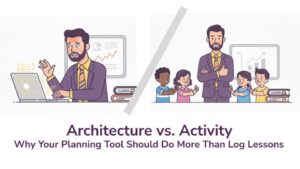 When we rely on a lesson-logger to simply follow a table of contents, we inadvertently outsource our instructional leadership. Your school’s unique mission, your students’ specific needs, and the evidence of faith you hope to see aren’t found in a publisher’s margins. True unit planning allows you to use the textbook as a powerful tool within a house you have already designed. You aren’t just “covering the book”; you are uncovering the mission.
Why “Lesson-First” Planning Falls Short
Current educational research highlights several cognitive and systemic deficiencies in platforms that prioritize logging over architecture:
- The “Tunnel Vision” Problem: Loggers focus on the 40-minute period, not the purpose. Research on Understanding by Design (UbD) emphasizes that planning must start with the “end in mind” rather than a chronological sequence of activities.
- The Redundancy Tax: Daily logs are standalone entries, meaning you often re-type the same mission alignment and standards every day. In a unit-based system like Atlas, you anchor these once, ensuring all activities align with overarching goals—a concept known as Curriculum Coherence.
- The Integration Gap: True spiritual formation doesn’t happen in 40-minute silos. It is nearly impossible to weave deep, faith-forming outcomes into a single day if they haven’t first been architected into a 6-week unit.
From Exhaustive Logging to Nimble Planning
The strategic advantage of a unit-first platform is that it allows your weekly plans to be nimble. When you anchor instruction in Broad Instructional Goals, your daily plans no longer have to carry the full weight of formal documentation.
| The Deficiency of the Lesson Log | The Liberation of the Unit Plan |
| Focuses on what happens in 40 minutes. | Focuses on who the student becomes. |
| The textbook is the curriculum. | The textbook serves the curriculum. |
| Plans must be “thick” to show alignment. | Plans are “nimble” because the unit holds the depth. |
| Reactionary: Recording the mile. | Anticipatory: Architecting the journey. |
Your Questions Answered
“If my lesson plans are less detailed, will I get in trouble with administration?” Not if your Broad Instructional Goals are robust. When you can show a high-quality Unit Map, it proves your “nimble” daily plans are backed by deep intentionality. You are trading quantity of data for quality of instruction.
“How does unit planning actually help with student faith formation?” Real formation requires seeing the “Big Picture”. When you plan at the unit level, you can identify natural, deep connections between your subject and the “head and heart” evidence you want to see. This prevents faith from feeling like a verse “tacked on” at the end of a lesson.
“I like my textbook’s flow. Why change?” You don’t have to change the flow, just the ownership. By mapping the unit first, you ensure the textbook is meeting your goals, not the other way around.
The Path Forward
The shift from granular logging to Instructional Architecture is a pedagogical necessity supported by decades of research. It allows for Adaptive Teaching, giving you the permission to pivot and follow profound student questions while remaining anchored to the broader roadmap.
Ready to architect a more intentional learning journey? I’d love to hear from you! As an instructional leader, how do you balance textbooks with your own broad learning goals? What strategies help you keep your daily planning nimble while staying true to your roadmap?
Michael Arnold
Michael Arnold is an educational strategist and curriculum integration specialist with over 15 years of leadership experience in education management. Currently serving as a Senior Solutions Consultant for faith-based schools at the Faria Education Group, he facilitates the implementation of mission-aligned technology solutions designed to optimize institutional efficacy and student outcomes.
Michael’s career is defined by a commitment to the advancement of independent and faith-based scholarship. He has previously held leadership roles in client relations and support management, where he supported and trained around curriculum mapping initiatives and standards alignment for private schools. His pedagogical foundation includes extensive experience as a curriculum consultant and six years of classroom instruction.
You can connect with Michael on LinkedIn.