Teaching Christianly: Making Faith Formation Visible in the Classroom
By Kent Ezell | Founder of Faith Journey
In many Christian schools, faith formation is central to the mission—but often difficult to see.
 We hope it’s happening. We believe it matters. But when we look closely at our systems—lesson plans, observations, assessments—we tend to focus on what’s easiest to measure: academic growth, classroom management, and instructional strategies. Meanwhile, the most important outcome—students growing in their faith—can remain largely invisible.
Hope, however, is not a system.
If faith formation is central to our mission, then we need to ask a different question:
What evidence shows that students are being invited to engage their faith in the everyday life of the classroom?
This is where our work becomes more intentional.
From Integration to Invitation
For years, Christian educators have talked about “integrating faith and learning.” While this language is helpful, it can sometimes lead to surface-level connections—adding a Bible verse here or a discussion question there.
Teaching Christianly goes deeper.
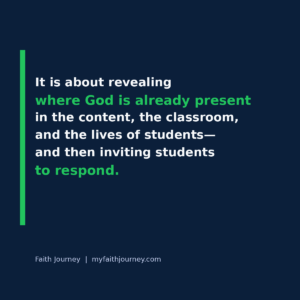 It is not primarily about adding faith into a lesson. It is about revealing where God is already present in the content, the classroom, and the lives of students—and then inviting students to respond.
These invitations might take many forms:
- Asking students to reflect on how a concept reveals something about God’s character
- Helping them name brokenness in the world connected to what they are learning
- Encouraging them to imagine how they might live differently in light of redemption
In each case, the goal is not just understanding, but response.
A Simple Framework: Planning, Teaching, Evidence
One way to think about this work is as a simple, reinforcing cycle:
Planning → Teaching → Evidence
- Planning begins with meaningful questions that connect content to God’s story
- Teaching creates opportunities for students to engage, reflect, and respond
- Evidence captures those moments so they are visible, shareable, and lasting
This is not about measuring faith itself, as that is the work of the Holy Spirit.
But it is about paying attention to the opportunities we create and the ways students respond.
When teachers begin to see this as part of their practice, something shifts:
- Faith engagement becomes more intentional
- Conversations deepen
- Students begin to recognize God in places they hadn’t noticed before
Why It Matters
Students will not naturally see God in all things.
They need teachers who are willing to point, name, and invite.
When this happens consistently—not just in Bible class, but across subjects—students begin to develop a faith that is connected to the whole of life, not separated from it.
And when we begin to notice and share evidence of these moments, we move from hoping faith formation is happening…
to seeing it take shape in real time.
 Kent Ezell and his wife Reba are the founders of Faith Journey. Faith Journey provides Christian schools with an easy-to-use web and mobile application that captures moments that help shape students’ faith. Students, teachers, and parents are then able to reflect on these experiences. Kent is currently a 5th grade teacher at Dutton Christian School.
He has served in a variety of educational roles, including middle school math and Bible teacher, university professor, admissions director, donor officer, school administrator, and CSI curriculum consultant. He and Reba have two children, Carolyn and Joshua.