Faith-Based Curriculum Mapping for Christian Schools
By Kyle Bruinooge | KB Consulting – Grand Rapids, MI| Guest Writer to Faith Journey
Introduction
Are you a Christian educator wondering how to make your curriculum truly reflect your school’s mission and biblical worldview?
You’re not alone. Many teachers and administrators wrestle with questions like:
- Where do we start with curriculum mapping?
- How do we integrate faith formation into our lessons?
- How can we document evidence of student growth in both faith and learning?
For Christian schools, curriculum is more than a checklist—it’s a living expression of faith. When done thoughtfully, curriculum mapping becomes a powerful tool for planning, enhancing, and documenting both academic and spiritual growth.
At Covenant Christian High School in Grand Rapids, MI, our journey with Curriculum Trak taught us that effective curriculum development doesn’t have to be overwhelming. It begins with reflection, grows through collaboration, and matures as teachers align learning experiences with their faith mission.
The Basics of Curriculum Development
When schools embark on curriculum mapping, the task can seem daunting. There’s the initial setup, organization, and the challenge of convincing teachers of its value. Then comes the ongoing work of maintaining momentum.
When we began mapping, I decided to start slowly—not because of hesitation, but out of care for my colleagues. I didn’t want to overwhelm them or risk losing buy-in too soon.
Two years later, I saw that the slow approach had value. It fostered teacher reflection and opened pathways for both curriculum and faith development. Reflection became the key—looking honestly at our best practices and how they serve our students and mission.
Why Reflection Matters
Curriculum mapping isn’t just about documenting what you teach—it’s about exploring why you teach it and how it aligns with your Christian mission. Reflection helps teachers at every level see where faith formation, academic rigor, and student engagement intersect.
Not every teacher will be immediately convinced—there are always a few skeptics—but most educators, once they pause to reflect, discover meaningful ways to grow in both skill and spiritual leadership.
My Own Mapping Experience
I’ve taught New Testament Survey for over ten years—forty-five iterations of the same course. One might assume that experience equals mastery.
Wrong.
When I mapped my own course more deeply than what was required, the findings were humbling. My formative assessments were inconsistent—some units had four, others had none. That variance revealed gaps in how I was checking for understanding.
Through mapping, I realized I relied too heavily on engaging lectures and not enough on reflection or questioning. By adding essential questions and time for student thinking, participation deepened. “Gleaner” students—those who process quietly—began sharing confidently. All because the mapping process encouraged intentional reflection.
Redefining Curriculum Development
There’s a misconception that curriculum development must be monumental—new textbooks, major programs, complete overhauls. Those can matter, but they’re not the essence.
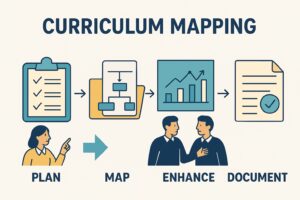 True curriculum development is simple: understanding your curriculum as a living expression of your school’s mission. It’s about reflecting, adjusting, documenting, and sharing in community.
Our Approach at Covenant
Each year, we focus on one key “field” of the curriculum map—biblical worldview, essential questions, or assessment strategies. We devote professional-development days to exploring that focus before teachers begin mapping throughout the year.
This approach is manageable and mission-driven. It builds culture, not compliance. Teachers grow through collaboration, and students benefit from well-aligned, faith-centered instruction.
For Christian Educators Everywhere
If you’re leading a Christian school or teaching in one, curriculum mapping can help you:
- Integrate faith formation intentionally into daily instruction.
- Strengthen vertical and horizontal alignment across subjects.
- Document evidence of faith learning and spiritual growth.
- Build student portfolios that reflect both knowledge and discipleship.
Call to Action
If your Christian school is ready to move beyond compliance toward meaningful curriculum development that integrates faith and learning, I’d love to help.
I offer customized support for:
- Faith-based curriculum planning and mapping
- Alignment and assessment documentation
- Evidence of faith learning and student portfolios
- Professional development for Christian educators
Let’s partner to make your curriculum a living reflection of your mission.
👉 Connect with me at KB Consulting to explore practical next steps for your team.
About the Author
 Kyle Bruinooge serves as teacher and curriculum director at Covenant Christian High School in Grand Rapids, MI. With over twenty years of classroom and leadership experience, he helps Christian schools design curriculum maps that integrate a biblical worldview and nurture both teacher and student growth.
The blog post was originally found on CurriculumTrak (now Atlas Curriculum Mapping)